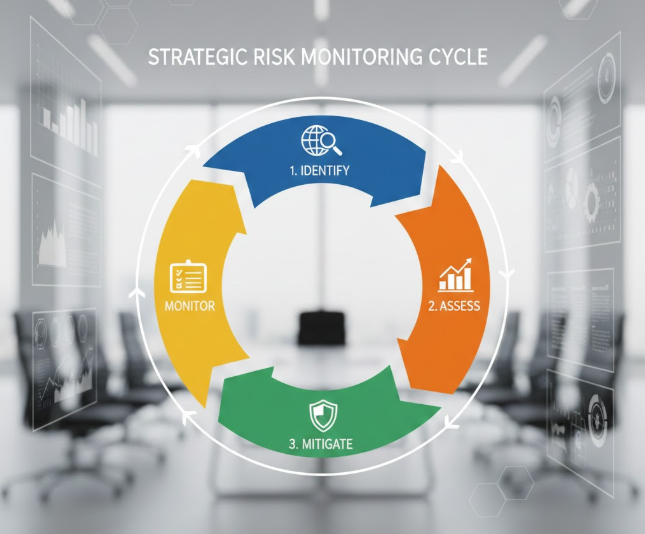

The world of finance is no longer just about picking the right stocks or balancing a ledger. In the modern era, Strategic Risk Monitoring (SRM) has become the backbone of corporate stability. For students entering this field, understanding SRM means learning how to identify, assess, and manage risks that could threaten a company’s very existence. Unlike operational risks—like a machine breaking down in a factory—strategic risks are high-level threats, such as a sudden shift in consumer behavior, new government regulations, or a global economic downturn. To master this, a student must transition from a “textbook” mindset to a “strategic” mindset, analyzing how external forces impact long-term goals.
However, the transition from being a student to a strategic analyst is a steep climb, especially when the pressure of final-year projects begins to mount. Many finance majors find themselves overwhelmed by the sheer volume of data required for their senior projects. This is often where academic pressure meets professional ambition; to maintain a high GPA while learning these complex financial models, many students seek out a professional dissertation writing service like myassignmenthelp to ensure their research is backed by expert analysis. Using such specialized support allows students to focus on the practical application of risk monitoring theories while ensuring their final academic papers meet the rigorous standards expected by future employers in the financial sector.
The Core Components of Strategic Risk Monitoring
To monitor risk effectively, you must first understand what you are looking for. Strategic risk isn’t just about “losing money.” It’s about the uncertainty of achieving a business objective. Finance students should focus on three primary pillars:
- Risk Identification: Constant scanning of the political, economic, social, and technological (PEST) landscape.
- Risk Assessment: Determining the probability of a risk occurring and the potential “hit” the company’s valuation would take.
- Risk Mitigation: Developing a “Plan B” before the crisis actually hits.
For a finance student, practicing these pillars is the difference between being a data entry clerk and a Chief Financial Officer (CFO). You aren’t just looking at what happened yesterday; you are predicting what might happen two years from now. This foresight is what makes a finance professional indispensable to a board of directors.
Why Data Literacy is Your Greatest Asset
In 2026, data is the “new oil” in the finance sector. You cannot monitor strategic risk without being comfortable with Key Risk Indicators (KRIs). These are specific metrics that act as early warning systems. For example, if a company’s “Customer Acquisition Cost” starts rising while “Customer Lifetime Value” drops, that is a strategic risk indicating a failing business model. Finance students must learn to use tools like Python or advanced Excel to visualize these trends before they become catastrophes.
The challenge for most students, however, is not just understanding the math, but choosing the right context for their research. If you are struggling to narrow down your focus for your final year, exploring various Business Management Dissertation Topics can provide the spark you need to connect risk monitoring with real-world corporate strategy. This specific area of study bridges the gap between numbers and leadership, helping you produce a paper that isn’t just a summary of facts, but a strategic document that showcases your readiness for the corporate world.
4. Implementing a Risk Monitoring Dashboard
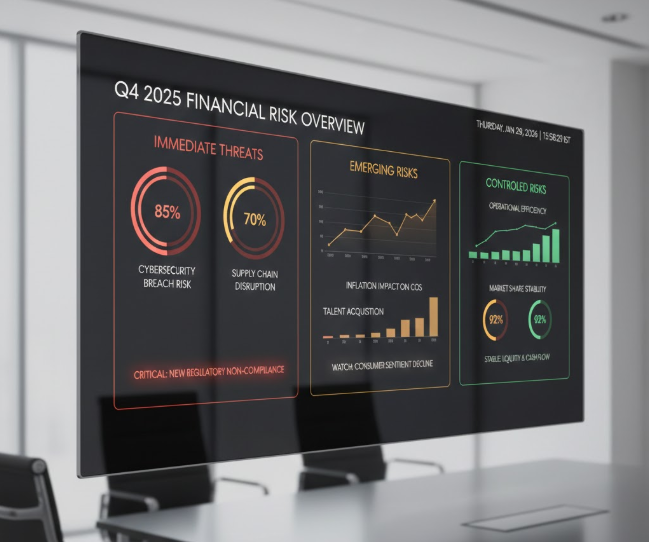
Once you enter the professional world, you won’t be writing essays; you will be building dashboards. A risk dashboard is a visual tool that summarizes the health of an organization.
- Red Zones: Immediate threats requiring board-level intervention.
- Amber Zones: Emerging risks that need closer observation.
- Green Zones: Controlled risks where the current strategy is working.
As a student, you can practice this by creating a mock dashboard for a Fortune 500 company. Analyze their annual reports (10-K filings) and identify what they list as “Risk Factors.” Then, track those factors over a six-month period. This hands-on experience is exactly what recruiters mean when they talk about “Experience” in the E-E-A-T framework. It shows you haven’t just read the theory—you’ve lived the data.
5. The Financial Impact of Procrastination and Risk
In finance, time is literally money. This concept is known as the “Opportunity Cost.” Just as a company loses value by delaying a product launch, a student loses financial potential by delaying their graduation. Every semester you spend struggling with a complex thesis is a semester of lost salary in the professional world.
By utilizing strategic monitoring in your own life—identifying where your academic weaknesses are and “outsourcing” the heavy lifting of proofreading or data structuring—you are practicing the very risk management you hope to do for a living. You are mitigating the risk of academic failure to secure the reward of a high-paying career.
6. The Future of Finance: AI and Human Judgment
While AI tools are becoming better at spotting patterns, they lack the “Human Judgment” required for strategic decisions. AI can tell you that a stock price is volatile, but it can’t tell you if a CEO’s personality is a risk to the company culture. This is why the human element of risk monitoring remains vital.
Finance students should focus on developing their Soft Skills. Can you explain a complex financial risk to a marketing manager? Can you convince a CEO to change course based on your data? These are the skills that lead to the “Authority” part of E-E-A-T. Being an expert is only half the battle; being a trusted advisor is the goal.
Conclusion: Your Roadmap to Success
Strategic Risk Monitoring is a journey, not a destination. It requires a curious mind, a love for data, and the ability to see the “big picture.” For finance students, the path forward is clear:
- Master the metrics that drive business value.
- Stay ahead of academic hurdles by using professional resources when necessary.
- Build a portfolio of real-world risk assessments.
By finishing your degree on time and with a deep understanding of risk, you aren’t just passing a class—you are protecting your future financial health.
Frequently Asked Questions
1. How does strategic risk differ from operational risk?
Strategic risk involves high-level uncertainties that threaten a company’s overall business model or long-term goals, such as market shifts. Operational risk focuses on internal failures, like technical glitches or human error in daily tasks.
2. Why should finance students care about risk monitoring?
Understanding risk monitoring is essential for career advancement. It shifts your role from simple data entry to high-level analysis, allowing you to provide the strategic foresight that modern employers and boards of directors demand.
3. Can poor academic performance impact my financial future?
Yes. Beyond just grades, failing to meet academic milestones can lead to lost scholarships, increased student loan interest, and a delay in entering the workforce, which creates a significant “opportunity cost” in lost wages.
4. What is the most effective way to manage a heavy academic workload?
Successful students use “strategic outsourcing.” This involves focusing your personal energy on core subject mastery while utilizing professional editing and research support to ensure your final projects meet high industry standards.
About the Author
Grace Turner is a senior academic consultant and financial researcher with over a decade of experience in higher education strategy. Known for bridging the gap between complex economic theory and practical student success, Grace provides deep insights into the evolving landscape of global finance. When not analyzing market risks, Grace collaborates with the expert team at myassignmenthelp to empower the next generation of business leaders through high-quality educational resources and mentorship.